
32-Hour Workweek
Same Pay – Fewer Hours
No one would seriously tell you that they wish they could work longer hours for less money. Yet, if we look at the “progress” provided under both Republican and Democratic leadership over the last half-century, that’s exactly what’s happened to the American worker—we work more for less pay.
Republican Party Platform, 1968:
“The forty-hour week adopted 30 years ago needs re-examination to determine whether or not a shorter work week, without loss of wages, would produce more jobs, increase productivity and stabilize prices.”
Over 80 years have now passed since the adoption of the 40-hour workweek. The Republican Party has long abandoned this platform plank of reducing the working hours. The Democratic Party has never even considered it. These two major parties by our time in the 21st century have been completely corrupted, bought and owned, by corporate control.
Today, fascists and capitalists around the world are considering increasing the number of hours people are required to work in order to live.[1] To those wealthy few, we are the indentured and enslaved. Our suffering is their profit.
As many commentators have pointed out, the global society has become more and more efficient and workers more productive, yet wages shrink lower and lower.[2]
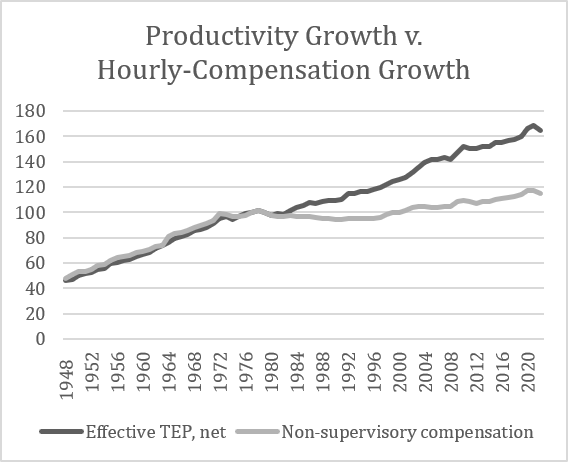
Source: Economic Policy Institute
The bill for a 32-hour workweek
SECTION 1. The Legislature finds and declares all of the following:
(a) It is the intent of the Legislature to institute a standard 32-hour workweek throughout California.
(b) Whenever a state or local law or regulation adopted before the passage of this bill refers to a 40-hour workweek, it shall now be considered to apply as if it spoke of 32 hours instead of 40, where appropriate to further the goal of setting the standard workweek to 32 hours.
(c) Wherever a state or local law or regulation adopted before the passage of this bill set a minimum hourly wage based on a 40-hour workweek, that wage is now intended to be adjusted to provide the same weekly wages within 32 hours instead of 40. The new applicable minimum wage amounts are therefore 1.25 times the previous amounts. For example, a minimum wage of $16.50 per hour ($660 for a 40-hour week) will now be a minimum wage of $20.63 ($660 for a 32-hour week).
SEC. 2. Section 510 of the Labor Code is amended to read:
510. (a) Eight hours of labor constitutes a day’s work. Any work in excess of eight hours in one workday and any work in excess of 40 32 hours in any one workweek and the first eight hours worked on the seventh sixth day of work in any one workweek shall be compensated at the rate of no less than one and one-half times the regular rate of pay for an employee. In addition, any work in excess of eight hours on any sixth day of a workweek and any work on the seventh day of a workweek shall be compensated at the rate of no less than twice the regular rate of pay of an employee. Nothing in this section requires an employer to combine more than one rate of overtime compensation in order to calculate the amount to be paid to an employee for any hour of overtime work. The requirements of this section do not apply to the payment of overtime compensation to an employee working pursuant to any of the following:
(1) An alternative workweek schedule adopted pursuant to Section 511.
(2) An alternative workweek schedule adopted pursuant to a collective bargaining agreement pursuant to Section 514.
(3) An alternative workweek schedule to which this chapter is inapplicable pursuant to Section 554.
(b) Time spent commuting to and from the first place at which an employee’s presence is required by the employer shall not be considered to be a part of a day’s work, when the employee commutes in a vehicle that is owned, leased, or subsidized by the employer and is used for the purpose of ridesharing, as defined in Section 522 of the Vehicle Code.
(c) This section does not affect, change, or limit an employer’s liability under the workers’ compensation law.
[With similar amendments to: Lab. Code §§ 204.2, 204.3, 246, 248, 248.1, 248.3, 248.7, 248.6, 510, 511, 513, 515, 515.7,751.8, 860, 1171, 1182.4, 1182.6, 1295.5, 1391, 1491, 1777.5, 1811, 1813, 1815; Gov. Code §§ 11020.1, 13957.5, 19851, 19852, 19996.20, 19996.23, 19996.36, 20635.1, 20636.1, 95021; Educ. Code §§ 45127, 45132, 45133, 45133.5, 45136, 45197, 78081, 88026, 88027, 88035, 88040, 88197, 89502, 89900; Fam. Code § 4055, 17404.1; Food and Ag. Code § 3203; Un. Insur. Code §§ 10201, 1279.5; Welf. And Inst. Code § 14199.71; Bus. And Prof. Code § 1635.5;]
[1] See Blake, Suzanne. “Businesses Are Moving to 6 Day Work Weeks”, 2024. Newsweek. https://www.newsweek.com/businesses-are-moving-six-day-work-weeks-1896283
[2] See “The Productivity-Pay Gap”. Economic Policy Institute. https://www.epi.org/productivity-pay-gap/